 Geirangerfjord Cruises
The Geiranger–Hellesylt Ferry: Fares, Timetable & What to Know
Last reviewed August 2026
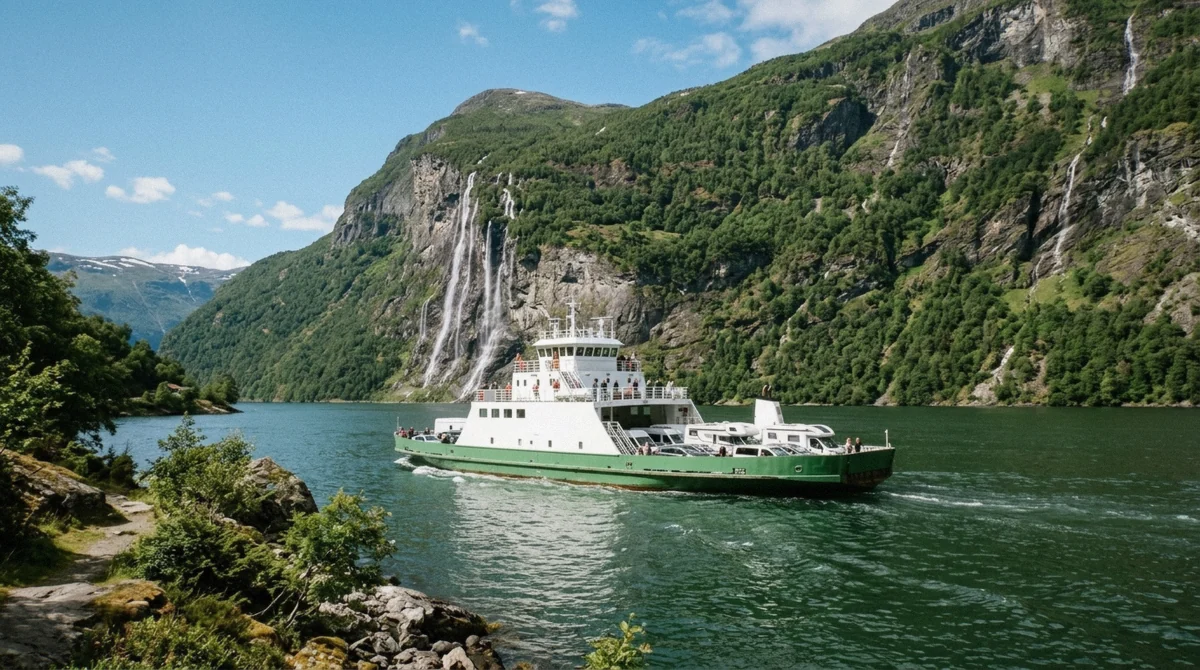
The geiranger hellesylt ferry is the Fjord1 car ferry that crosses the full length of the Geirangerfjord in about 65 minutes, connecting Geiranger to the village of Hellesylt at the fjord's western mouth. Traveller fares start from 390 NOK, about $38 at the August 2026 rate, and the crossing passes directly beneath the Seven Sisters and Bridal Veil on the way. This guide covers real fares, the vessels, check-in times, booking rules, and how the plain ferry compares to a guided round-trip cruise that does the same route with commentary and a waterfall-tasting stop.
Quick answer
The Geiranger–Hellesylt ferry is a Fjord1 car ferry crossing in about 65 minutes, with traveller fares from 390 NOK (roughly $38, August 2026). It carries cars, campervans and foot passengers, and doubles as sightseeing, passing beneath the Seven Sisters on the way.
Key takeaways
- Crossing time: about 65 minutes, operated by Fjord1
- Traveller fare from 390 NOK (~$38); vehicle fares run higher, see the fares section below
- Book ahead May to September if you're bringing a vehicle; walk-ons usually board without a reservation
- Prefer commentary and a stop instead of a plain crossing? The guided round trip covers the same water with an hour ashore
- Want the view without crossing at all? A one-hour cruise from Geiranger sees the same falls and turns back
Quick Comparison: Ferry, Tour or Cruise
Three ways to cover this water
As of August 2026. The plain car ferry is the cheapest way across and the only one that carries vehicles; the two guided options add commentary and, in one case, a stop ashore.
| Option | Time | Cost | Best for |
|---|---|---|---|
| Fjord1 car ferry (foot passenger) | about 65 minutes | from 390 NOK (~$38) | Point-to-point travelers and anyone bringing a car |
| Guided round trip with stop in Hellesylt | 2.5 hours | $83.84 | Round-trip travelers who want commentary and an hour ashore |
| One-hour waterfall-tasting cruise | 1 hour | $57.64 | Seeing the falls without crossing to Hellesylt at all |
Our pick
If you actually need to get from Geiranger to Hellesylt, or vice versa, and you don't need commentary, the plain Fjord1 ferry is the cheapest and most direct option and the only one that takes a car. If you're staying in Geiranger and just want the water and the falls, the one-hour cruise turns back without the extra time crossing to a town you don't need to reach. And if the point of the day is simply being on the fjord with a guide narrating what you're looking at, the round trip with the Hellesylt stop bundles the crossing, the return leg and an hour ashore into one booking, which removes the planning the plain ferry otherwise leaves to you.
Where It Departs
The full route from the Geiranger quay to the Hellesylt ferry landing, with the Seven Sisters marking the midpoint of the crossing.
Fares & Booking
What it costs
As of August 2026, a traveller (foot passenger) fare starts from 390 NOK, about $38 at the current rate, booked via Fjord Tours. Vehicle fares are priced by length and vary by season; check Fjord1's current price list before you travel rather than relying on an old figure. Check-in is 30 minutes before departure if you're bringing a vehicle, or 15 minutes on foot. Bookings can be changed or refunded free of charge up to 48 hours before departure.
Booking ahead is strongly advised from May through September if you have a vehicle, since deck capacity is limited and fills on busy summer days; walk-on foot passengers usually board without a reservation even in high season. For the current timetable and official fares, see Fjord1's timetable and prices and visitgeiranger.com's ferry page.
A few practical notes worth knowing before you show up at the quay. Tickets can be bought online in advance or, for foot passengers, often simply paid for at a small ticket point near the quay, though pre-booking a vehicle spot removes any uncertainty. There is no reliable luggage storage at either the Geiranger or Hellesylt ferry quay itself, so if you're arriving with bags for a same-day return, plan around your hotel's storage rather than counting on lockers at the dock. The crossing is not fully step-free either; a car ferry has a vehicle deck and stairs to the passenger lounge, manageable for most travelers but worth knowing if mobility is a concern.
On Board
What the crossing is like
The ferry runs on vessels MF Veøy and MF Bolsøy, both car ferries with an open deck, a café or kiosk, and toilets. Commentary runs in several languages over the crossing, pointing out the Seven Sisters and Bridal Veil, along with the farms perched on the cliffs, as the boat passes beneath them. It is a working car ferry rather than a dedicated sightseeing boat, but the route it runs is effectively the same one the tour boats sell tickets for.
Most passengers split their time between the open deck, best for photographs as the Seven Sisters come into view, and the enclosed lounge, useful if the wind picks up or the crossing runs into rain. Because the vessel also carries vehicles, expect a mix of drivers staying near their cars and foot passengers moving freely around the passenger areas. The crossing runs at a steady pace rather than pausing for photo stops the way a dedicated sightseeing cruise does, so the view unfolds on its own schedule rather than the tour's.
The one-way problem
Because the ferry only runs one direction per sailing, a foot passenger who crosses without a car needs a plan for getting back: either book the return sailing to Geiranger the same way, or continue onward from Hellesylt by road if that fits the wider itinerary. Travelers starting from Ålesund rather than Geiranger can reach the fjord an entirely different way, on the Ålesund round trip cruise, which sails directly into the Geirangerfjord and never touches the Hellesylt ferry route at all.
Ferry vs. Guided Cruise
Fjord1 car ferry, from 390 NOK
- Cheapest way to cross, and the only option that carries a car or campervan
- One-way, point-to-point, no return leg included
- Café/kiosk on board, commentary in several languages
- Best if you actually need to get to or from Hellesylt, not just see the water
Guided round trip with Hellesylt stop, $83.84
- Return trip built in, no need to arrange getting back
- Includes a stop to taste water at the Friaren waterfall
- An hour of free time ashore in Hellesylt before heading back
- Dedicated commentary aimed at sightseeing rather than transit
Verdict Take the plain ferry if you need to be in Hellesylt for a reason beyond the ride, or if you have a car to move. Take the guided round trip if the point of the day is the water itself and you'd rather not plan your own way back to Geiranger.
Seasonal & Schedule Changes
When it runs
The core season runs spring through autumn; Fjord1 lists the route as running April through October, while the Fjord Tours booking product for this route shows availability from May 1 through December 15 for 2026. The safest approach is to check the current timetable directly before you travel rather than assume last year's schedule holds, since departures thin outside the core months. Multiple daily departures run in high season, dropping to a reduced schedule at the edges of the year, and travelers planning a trip for the shoulder months of April, October or November should confirm the ferry is still operating on their exact dates before building an itinerary around it.
What to Do in Hellesylt
A small village with a waterfall through its middle
Hellesylt itself is compact: a village waterfall runs right through the centre, with a smaller bridge that gives the best view of it, and the village carries a Mission: Impossible filming history from a stunt sequence shot nearby. It's a walkable size, so even an hour is enough to see the waterfall, cross the bridge and get a feel for the place before heading back to the quay. If you want more than a quick look around, the guided round trip with a Hellesylt stop is built around that hour ashore and covers it in full, with commentary along the way rather than a self-guided wander.
Accessibility & Traveling with Kids or Gear
What to expect if mobility, strollers or luggage are a factor
The ferry itself is a working car ferry, not a purpose-built passenger boat, so getting from the vehicle deck to the passenger lounge involves a set of stairs; there is no dedicated lift, which is worth knowing for wheelchair users or anyone with limited mobility. Strollers are manageable on the flat sections of the deck and lounge, though the stairs are unavoidable if you want the enclosed seating. Families traveling with young kids generally find the open deck the easiest place to be during the crossing, with the enclosed lounge as a fallback if the weather turns.
Luggage handling is straightforward for anyone driving on with a vehicle, since bags simply stay in the car. Foot passengers carrying suitcases should expect to manage their own bags up and down the stairs to the lounge, as there is no porter service and no locker storage at either quay.
Questions About the Geiranger–Hellesylt Ferry
How much does the Geiranger–Hellesylt ferry cost?
A traveller (foot passenger) fare starts from 390 NOK, about $38 as of August 2026. Vehicle fares are priced separately by length via Fjord1's current price list.
How long does the ferry take?
About 65 minutes for the full crossing between Geiranger and Hellesylt.
Do I need to book the ferry in advance?
Booking ahead is strongly advised from May through September if you're bringing a vehicle, since deck space is limited. Foot passengers can usually walk on without a reservation even in high season.
Does the ferry take cars?
Yes. The vessels MF Veøy and MF Bolsøy carry cars, campervans and foot passengers. Check-in is 30 minutes before departure with a vehicle, or 15 minutes on foot.
Which side should I sit on for the best view?
The Seven Sisters and Bridal Veil come into view as the ferry passes roughly the midpoint of the crossing; either side gives a clear look as the boat runs close to the cliffs, so there isn't a strongly better side to book.
Can I change or cancel my ferry booking?
Yes, free of charge up to 48 hours before departure.
Is the ferry the same route as the guided boat tours?
It runs the same stretch of water, past the Seven Sisters and the farms, but as a working car ferry rather than a dedicated sightseeing boat. The guided round trip covers the same water with commentary and a stop ashore built in.
Is there wheelchair access on the ferry?
Not fully. The vessels have a vehicle deck and stairs up to the passenger lounge with no lift, so wheelchair users should plan around that or consider a wheelchair-accessible sightseeing cruise instead.
For most visitors who just want the fjord and don't need to move a vehicle, one of the guided Geirangerfjord cruises compared on our homepage will cover the same water with less planning around timetables and return legs. For anyone actually crossing to or from Hellesylt, the plain Fjord1 ferry remains the cheapest and most direct way to do it.